

The lowest hourly rate can conceal the costliest commitment. Evaluating GPU as a service contract terms means comparing contract length and minimum spend, billing increments, usage limits, and ownership of data and work product. For variable workloads, no-contract, pay-as-you-go access with per-minute or per-second billing can preserve flexibility and reduce charges for idle capacity.
Price matters, but the billing model determines how that price changes as workloads shift. A useful comparison of GPU as a service contract terms also covers storage, data transfer, payment timing, cancellation provisions, and capacity-use limits. This guide explains how those terms affect total cost and flexibility, what to examine in data ownership and intellectual property clauses, and how to weigh on-demand access against longer commitments. Compare the terms against the capacity your workloads need and the obligations your organization can accept.
Key Takeaways
- Compare commitment length and minimum spend against how reliably your workload will need GPU capacity.
- Look beyond the GPU rate: memory, storage, data transfer, and included services all shape total cost.
- Clarify who owns your data and workload outputs, and what rights apply to software, models, and other intellectual property.
- Match billing increments and payment terms to actual usage so idle capacity and changing demand don’t drive avoidable costs.
Long-term contracts and minimum-spend commitments
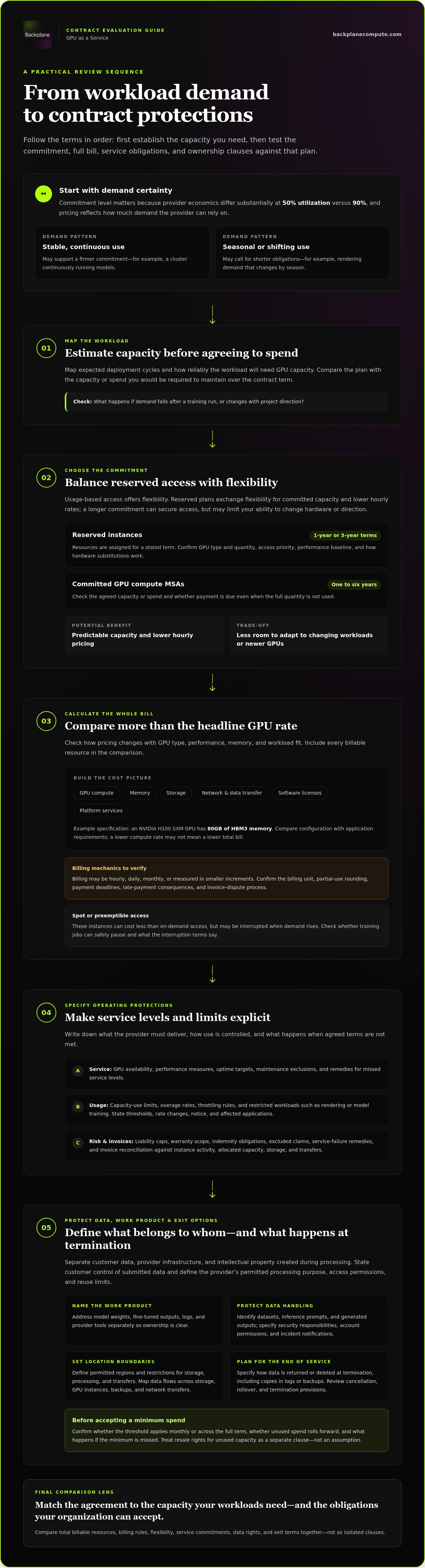
Before signing, match the commitment to expected demand: reserved-instance contracts commonly run 1-year or 3-year terms, while committed GPU compute MSAs commonly last one to six years. Specify GPU availability, performance measures, uptime targets, maintenance exclusions, and remedies for missed service levels. Also define usage limits, overage rates, throttling rules, and restricted workloads, such as rendering or model training.
Commitment Levels and Demand
Commitment level is the capacity or spend a buyer agrees to maintain over a defined contract term. It matters because provider economics differ substantially at 50% utilization versus 90%, and pricing reflects how much demand the provider can rely on. Map expected deployment cycles before accepting a minimum spend. For example, a stable cluster running models continuously may support a firmer commitment than seasonal rendering demand.
Reserved Capacity and Volume Obligations
Reserved capacity assigns GPU resources for a stated term. A committed-volume obligation requires the buyer to pay for an agreed quantity, whether it is fully used or not. The contract should specify the GPU type and quantity, access priority, performance baseline, and how hardware substitutions work. For an NVIDIA cluster, clarify whether unused capacity can be resold or transferred, and note any approval requirements.
Commitment Trade-Offs
A longer commitment can secure access and lower hourly pricing, but it reduces flexibility if workloads or hardware needs change. Reserved terms may limit your ability to move to a newer GPU released during the contract or adapt to a change in project direction. Compare that risk with the deployment plan: a team training the same models steadily may value predictable capacity, while shifting workloads may call for shorter obligations.
Review minimum-spend language just as carefully. Establish whether the threshold applies monthly or across the full term, whether unused spend rolls forward, and what happens if you miss a minimum. If demand may fall after a training run, rollover and termination provisions can significantly affect the effective cost. Treat resale rights as a separate clause, not an assumed way to offset unused capacity.
Pricing differences by GPU, memory, and included services
GPU-as-a-Service pricing is generally usage-based, while reserved plans exchange flexibility for committed capacity and lower hourly rates. Reserved-instance contracts commonly run 1-year or 3-year terms. Contract terms should also distinguish on-demand access from spot or preemptible instances, which can be interrupted when demand rises.
GPU type and performance shape the rate, but memory and workload fit shape value. An NVIDIA H100 SXM GPU has 80GB of HBM3 memory, a specification relevant to intensive training and large models. Compare the GPU configuration against application requirements, then account for storage, network consumption, software licenses, and platform services. A lower compute rate may not mean a lower total bill if data movement or licensed tools add charges.
GPU-as-a-Service access may be billed by the hour, day, or month, or measured in smaller increments. The agreement should specify the billing unit, how partial usage is rounded, payment deadlines, late-payment consequences, and the process for disputing an invoice. Reconcile invoices against instance activity, allocated capacity, storage, and data transfers. Spot and preemptible pricing can reduce charges compared with on-demand access, but interruption terms matter for training jobs that cannot safely pause.
Set liability caps, warranty scope, indemnity obligations, and remedies in explicit clauses. Define which losses fall under a cap, which claims are excluded, what each party must defend, and whether service failures trigger credits, replacement capacity, or termination rights. These terms allocate risk, but they do not replace a clear service description. For usage limits, overages, throttling, and workload restrictions, specify thresholds, rate changes, notice, and affected applications.
For workloads with variable demand, compare the operational value of flexible GPU capacity access against reserved instances. Include every billable resource in the comparison, not only the headline compute rate.
Client data ownership and intellectual property
GPU contracts should distinguish customer data, provider infrastructure, and intellectual property created during processing. These boundaries affect model training, inference, privacy, and what happens when service ends.
Data Ownership and Processing
Data ownership and processing clauses define who controls submitted data and derived outputs, as well as who can access them during GPU workloads. This matters when an enterprise uses its own datasets to train models on provider infrastructure. State that customer data remains under customer control, then define the provider’s permitted processing purpose, access permissions, and limits on reuse. Address model weights, fine-tuned outputs, logs, and provider tools separately so ownership of important work product is clear.
Specify each party’s security responsibilities, including account access, role permissions, and incident notification procedures. Identify the data involved, such as training datasets, inference prompts, and generated outputs. Explain how data will be returned or deleted at termination, including copies in logs or backups.
Data Residency Requirements
Regional data-residency terms identify where data may be stored, processed, and transferred. In the United States, requirements depend on the data category, customer obligations, and processing locations. Define permitted regions and restrictions directly in the agreement so teams can assess whether the infrastructure locations meet their privacy and compliance needs.
Map data flows across storage, GPU instances, backups, and network transfers. The contract should identify subprocessors and state whether processing or support access may occur outside the agreed region. For sensitive workloads, align these terms with applicable customer obligations and internal data-handling rules.
Address backups separately. Identify who creates them, who can restore them, and how long copies remain after deletion. For example, a team running inference on customer records should know whether those records appear in diagnostic logs or recovery copies. Set customer responsibilities for securing credentials and maintaining independent copies of essential datasets.
Finally, separate compute charges from storage and egress charges. A large training dataset may incur transfer costs when moved into or out of the GPU environment, while retained checkpoints use storage. Define how transfer is measured, which movements are billable, and how invoices show those charges. This makes data movement visible in the total cost, not just the headline GPU rate.
On-demand GPU service terms and payment
On-demand terms suit workloads that rise and fall, because teams pay for compute time instead of buying hardware upfront. GPU-as-a-Service access may be billed by the hour, day, or month; per-minute or per-second billing can reduce charges for idle machine time. For most startups and independent researchers, no-contract, pay-as-you-go access preserves flexibility in GPU choice.
Read the billing clause as a measurement rule, not just a rate. It should explain when an instance starts billing, when charges stop, how partial intervals are rounded, and whether storage or network activity remains billable after compute ends. For example, shutting down a training machine may stop compute charges while stored checkpoints continue to use capacity. Keeping data close to the GPU platform can limit transfer charges.
Payment terms should specify invoice frequency, due dates, accepted payment methods, taxes, and any advance deposit or prepaid balance. They should also explain how invoice disputes work, including what evidence is used to reconcile billed usage with platform records. Compare each invoice against instance hours, storage, and data transfers. The agreement should state whether a disputed line item affects payment of undisputed charges.
Usage limits can constrain how often or how long a customer runs a GPU. The contract should define those limits, overage treatment, throttling triggers, workload restrictions, and notice before access changes. It should also state remedies for outages and allocate liability for service interruptions or billing errors. A clear deadline for submitting disputes helps prevent unresolved charges from carrying into later invoices.
For flexible compute demand, explore GPU capacity options that align with your workload pattern.
Backplane: GPUs-as-a-Service
Backplane connects organizations seeking GPU capacity with AI compute infrastructure through GPUs-as-a-Service. This is a practical next step when contract comparisons point to flexible access rather than a hardware purchase or long-term reserved commitment. Buyers with sustained demand can also consider Dedicated Financed Sites, while Property Viability Assessment and Infrastructure Financing Structuring support the conversion of suitable industrial assets into compute infrastructure.
The right route depends on workload patterns, capacity requirements, and how much infrastructure commitment your organization intends to take on. Use the contract criteria above to clarify those needs before deciding which model fits. Contact Backplane to discuss your GPU compute requirements.
Make the next compute decision deliberate
Your next GPU commitment should fit the operating model you intend to build, not just the workload in front of you. A careful review of GPU as a service contract terms helps align the agreement with how your organization expects to access and develop compute capacity. The right structure keeps infrastructure choices connected to business priorities as projects evolve.
Backplane offers GPUs-as-a-Service for organizations seeking GPU capacity, and Dedicated Financed Sites for those pursuing dedicated infrastructure. Property Viability Assessment can help evaluate whether an industrial site has potential for compute use. Use GPU as a service contract terms as a framework for matching your infrastructure path to your operating priorities. Discuss GPU contracts with Backplane and identify a practical direction for your infrastructure strategy.
Frequently Asked Questions
How Do I Evaluate a GPU as a Service Provider?
Evaluate providers against the workload you plan to run, not a generic GPU specification. Compare performance using a representative application, then assess integration with your existing platform, capacity flexibility, infrastructure reliability, and support processes. For example, a team serving live inference should examine response consistency under expected traffic, while a research team may prioritize sustained model-training throughput and compatible software.
How Does GPUaaS Billing Work?
GPUaaS billing covers GPU access and may also include storage, network transfer, or software charges. Match platform usage records to invoices, especially when teams create temporary instances or retain checkpoints after compute stops. For a short inference test, record which resources remain active after the test ends. This helps distinguish compute consumption from other billable activity.
What terms are typically included in a GPU-as-a-service contract?
A GPU-as-a-service agreement typically combines a master agreement with an order or service schedule that defines subscribed capacity and commercial terms. It also addresses service availability, acceptable workloads, security responsibilities, data handling, intellectual property, liability, and dispute procedures. Review amendment and termination language closely: it determines how changes to GPU configurations, project scope, or account access take effect.
How are GPU-as-a-service prices calculated, and what are typical rates?
Pricing depends on GPU type and performance, usage duration and frequency, storage, network consumption, and software or platform licenses. A single typical rate can mislead because configuration and supporting resources change the total. Compare providers using the same GPU class, workload duration, storage needs, and transfer pattern. Assess the expected bill as a whole rather than treating the compute charge as the full cost.
What data security, privacy, encryption, and compliance terms should GPU-as-a-service agreements include?
Specify encryption in transit and at rest, user authentication, role-based access, monitoring, software updates, and isolation between GPU environments. Define what data the provider processes, where it may be stored, and how support access works. For workloads containing sensitive prompts, document retention, deletion, incident notification, and backup handling. Align these provisions with the organization’s data obligations and internal controls.
Who owns customer data, model outputs, and intellectual property under a GPU-as-a-service contract?
The agreement should distinguish customer-provided data, generated outputs, trained model artifacts, and the provider’s pre-existing software or tools. State who may use each category and whether any rights continue after service termination. For example, a company fine-tuning a model should define rights to its resulting weights separately from rights to provider platform components. Clear definitions reduce ambiguity when teams export work or change infrastructure.


