

A GPU is only one part of a financeable AI compute buildout. GPU cloud infrastructure financing may cover servers, networking, power and cooling equipment, racks, deployment equipment, and other approved project costs. The structure depends on the assets, deployment plan, site, and repayment source.
Hardware gets the attention, but power, cooling, data-center space, and customer demand determine whether a project can support financing. This article explains which GPU and infrastructure costs may qualify, how documented commitments and on-demand revenue affect repayment analysis, and what changes when deployments span multiple sites. You’ll learn the main factors shaping a financing structure, the information typically needed to evaluate a project, and how to assess fit before scaling capacity. The focus is practical: align equipment and infrastructure with a credible deployment and revenue plan.
Key Takeaways
- Separate contracted customer demand from on-demand sales when assessing repayment capacity; lenders weigh their revenue risks differently.
- Build a complete project cost picture that includes servers, networking, power, cooling, racks, and deployment costs.
- For multi-site plans, assess debt-service coverage and align customer commitments, site arrangements, and debt terms.
- Prepare a clear equipment list, deployment plan, facility details, and revenue evidence to help shape a financing structure.
Can on-demand revenue be financed?
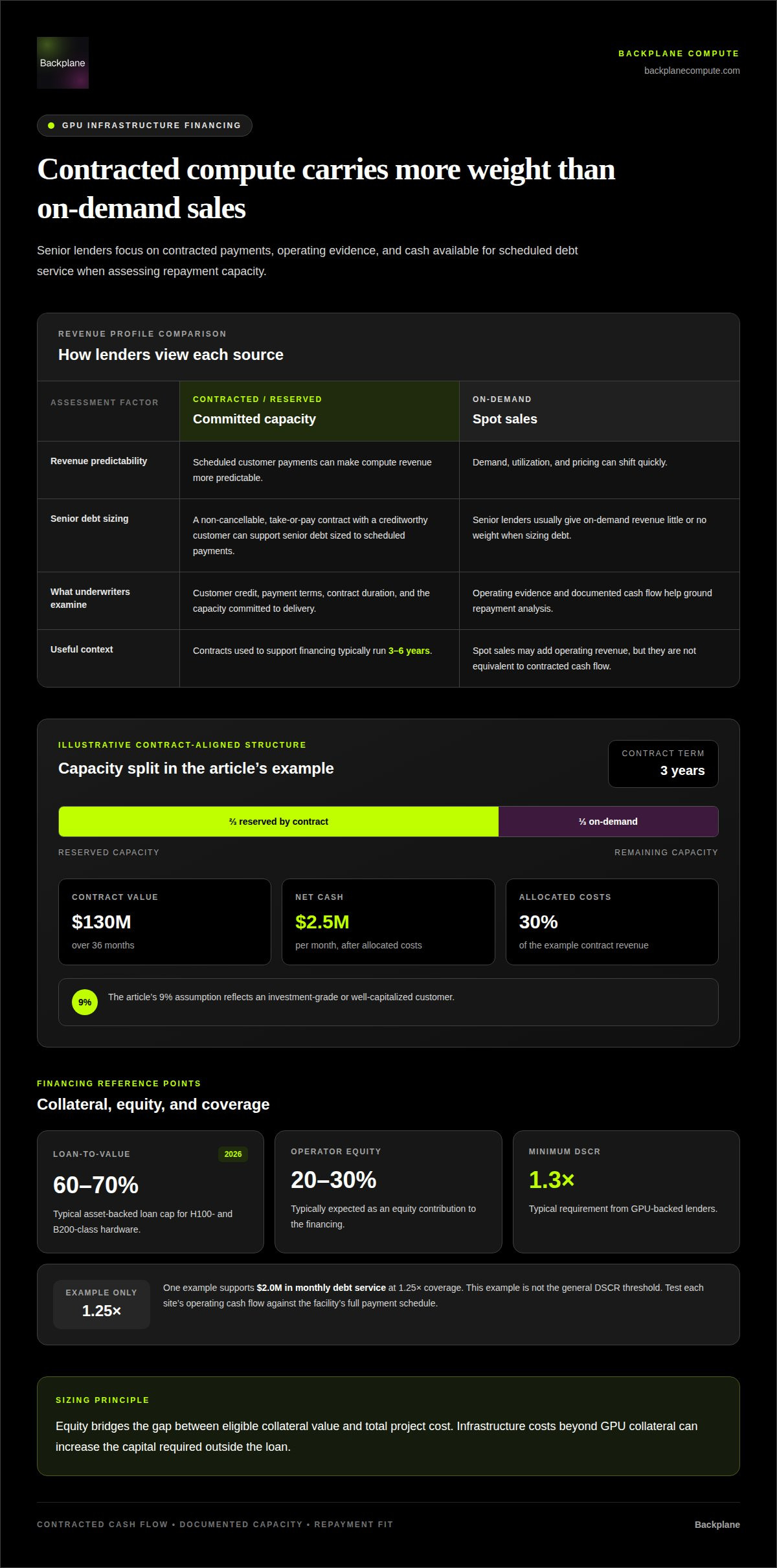
On-demand sales can add revenue, but senior lenders usually give them little or no weight when sizing debt. They focus more on contracted payments, operating evidence, and cash available for scheduled debt service.
Contract-Aligned Infrastructure Financing
A financing structure can align debt with installed capacity and customer start dates. Reserved contracts cover two thirds of capacity for three years; the rest sells on demand. Those contracts total $130 million over 36 months and generate net cash of $2.5 million per month after allocated costs of 30%. The 9% assumption reflects an investment-grade or well-capitalized customer.
Equity Contributions and Loan-to-Value Limits
Equity closes the gap between eligible collateral value and total project cost. For H100- and B200-class hardware, asset-backed loans are typically capped at 60-70% loan-to-value in 2026. Operators funding these loans are typically expected to contribute 20-30% of the financing as equity. Evaluate both measures against the project budget: infrastructure costs beyond GPU collateral can increase the capital required outside the loan.
Offtake Contracts as Lender Collateral
An offtake agreement can support underwriting by making compute revenue more predictable. Contracts used to support financing typically run for 3-6 years. A non-cancellable, take-or-pay contract with a creditworthy customer can support senior debt sized to its scheduled payments. Lenders assess the customer’s credit, payment terms, contract duration, and the capacity committed to delivery. The agreement supports repayment analysis; it does not make on-demand sales equivalent to contracted cash flow.
That distinction matters as market rates move. Because utilization and pricing can change quickly, senior lenders usually assign on-demand revenue little or no weight when sizing debt. Operators can present spot sales as additional operating revenue, while grounding repayment capacity in enforceable commitments and documented cash flow.
GPU hardware and data-center infrastructure costs
Financing can cover more than GPUs: deployment budgets may include networking, power, cooling, racks, and installation. Model the complete asset package before sizing a facility.
Power, Colocation, and Hardware Costs
GPU hardware represents 50-60% of total AI infrastructure cost. Include power and cooling equipment, data-center space, networking, and deployment costs in the same project model. For colocation, align contracted space and power with the deployment schedule and financing term.
Leasing, Equipment Loans, and Project Finance
Equipment loans finance eligible hardware, while operating leases leave ownership with the lessor during the term. Operating leases typically run 24-36 months; equipment loans for established companies are listed at 8-12% interest. Project finance can assess a broader infrastructure buildout and its repayment sources. In the U.S., tax incentives or government support depend on project location, eligible assets, and applicable program terms. Evaluate those factors separately rather than assuming they lower financing needs.
Hardware Financing Terms and Collateral
In financed ownership, the buyer takes title to eligible equipment, subject to the lender’s lien and final transaction documents. Finance lease interest rates are listed at 8-15%, depending on creditworthiness. A lender evaluates the equipment’s value, useful life, vendor, and resale risk when considering collateral. Qualifying recovered or refurbished GPUs may also be considered, depending on condition, provenance, inspection, warranty, and marketability.
Hardware Scaling, Refresh, and Financing Risks
GPU economic life is 3-4 years, and economic depreciation can reach 30-40% in the first year. That creates exposure if debt extends beyond the hardware’s productive or resale window. Utilization is another key risk: underused capacity weakens operating revenue, while rapid refresh cycles can require new capital before existing obligations are repaid. Match deployment stages and refresh plans to expected demand. For projects combining equipment with site needs, infrastructure financing structuring can bring those components into one financing plan.
Can several sites or customers be financed in one facility?
Yes. A facility can support successive deployments or pool customers across sites. Its structure must connect repayment capacity, site terms, and equipment performance.
Debt service coverage ratio (DSCR) compares cash available for debt payments with scheduled debt service. GPU-backed lenders typically require a minimum DSCR of 1.3x. One example supports monthly debt service of $2.0 million at 1.25x coverage. Treat that as an example, not the general threshold. Test each site’s operating cash flow against the facility’s full payment schedule.
Matching the loan term to the physical buildout matters. Lenders look for contracted power and data-center space lasting at least as long as the debt term. Align deployment dates, site commitments, and debt maturity so capacity can operate throughout repayment. For multiple customers, pool contracts and cash flows where the facility permits. This can reduce reliance on any one customer while keeping each contract’s contribution visible.
Turnkey AI infrastructure can package compute equipment with the site and operating arrangements needed to bring capacity online. For a multi-site rollout, map each deployment’s power, networking, customer contracts, and operating responsibilities. Neoclouds can finance successive deployments through a facility on agreed terms as contracts are signed, or pool deployments and customers. NFS Capital reports financing six separate transactions for one AI cloud services company in 2025 and 2026.
GPU-as-a-Service revenue can be billed by usage, but demand and utilization can shift. Hourly pricing gives customers flexible access; reserved contracts offer more predictable capacity and revenue. Compare both with debt obligations, customer concentration, and the equity available for expansion. Track utilization and customer payments by site instead of relying on a single consolidated forecast.
Before combining locations, assess credit support, contract concentration, and each site’s contribution to the balance sheet. NFS Capital reports that those six transactions totaled more than $15 million in AI server infrastructure. A staged facility can connect additional deployments to signed demand, while a pooled structure spreads exposure across customers and locations.
Financing GPU servers and AI compute infrastructure
Financing a compute platform means matching capital to assets, deployment, and repayment. AI cloud startups have obtained over $11 billion in financing by pledging NVIDIA chips as collateral. Morgan Stanley estimates about $800 billion in private credit will be needed for AI infrastructure buildouts through 2028.
For non-hyperscale operators, GPU-backed private-credit SPV facilities typically range from $20M-$500M in 2026. Buildouts of 500 to 2,000 H100s mark a scale where smaller operators need to assemble a financing structure. A lender evaluates the equipment, repayment source, business, deployment plan, geography, and documentation. The financing purpose should connect each funded asset to the compute capacity it supports. For crypto and digital asset infrastructure ventures establishing international corporate entities alongside their compute projects, corporate services firms such as Consulting24 assist with overseas business registration.
Capital stacks can combine senior debt with equity or junior capital. Before an operator has a credit track record, GPU-backed private-credit facilities typically cost 8-15% all-in annually. Non-recourse GPU loans typically carry rates 2-3 percentage points higher than recourse structures. GPU-backed SPV facilities may also include monitoring and custody fees of 0.5-1%. Rated investment-grade GPU facilities may offer loan-to-value ratios of up to 70-80%.
Choose a structure that fits asset ownership, customer contracts, and cash flow. Transaction documents establish collateral rights and payment obligations. Lenders typically expect monthly reporting on customer payments, utilization, and uptime, plus notice of customer defaults, service credits, or site changes. Consistent reporting links operating performance to repayment capacity. A deployment plan should also show how server delivery, site readiness, and revenue commencement fit together.
Prepare company and ownership information, financial statements, vendor quotes, equipment details, facility information, revenue evidence, and compliance records. Then map each payment source to the debt schedule and identify where equity fills the capital gap. A strong financing plan ties hardware, site, and customer economics together. Assess your AI infrastructure financing structure against the deployment and cash-flow plan.
Backplane: GPUs-as-a-Service
Backplane connects compute demand with infrastructure pathways. If you need GPU capacity without building and financing a full site, GPUs-as-a-Service provides direct access to compute. If your plan calls for dedicated infrastructure, Dedicated Financed Sites can align a site with deployment needs. A Property Viability Assessment evaluates whether an underused industrial property can support a GPU farm. Infrastructure Financing Structuring brings the project’s assets, site, and capital requirements into one plan.
The right route depends on your operating model: immediate compute access, a dedicated site, or a property-led conversion. Start with your capacity requirements, available power and space, and revenue plan. Contact Backplane to discuss your project, or visit backplanecompute.com.
Turn the financing plan into a deployment path
The next step is to connect the financing structure to an executable operating plan. Set out the capacity you intend to deploy, the sites that can support it, and the sequence for bringing each asset into service. Then align customer demand, capital requirements, and cash flow with those milestones. This gives decision-makers a clear view of what must happen before the infrastructure can generate revenue.
GPU cloud infrastructure financing works best as part of a broader deployment plan, not as a standalone equipment decision. Bring the commercial plan and physical infrastructure into the same conversation. Backplane can help shape that path around your compute requirements and site strategy.
Discuss your financing plan with Backplane and move your project toward its next milestone.
Frequently Asked Questions
What GPU and AI infrastructure can be financed?
Financing may cover GPU servers and supporting AI infrastructure, including networking, power and cooling equipment, racks, and deployment costs. Recovered or refurbished GPUs may also qualify for consideration. Their condition, provenance, inspection results, warranty, useful life, vendor, market value, and resale risk can affect how lenders assess them as collateral. An equipment list tied to the deployment plan helps clarify what the project requires.
Do lenders prefer one hardware vendor?
Vendor identity is one part of equipment diligence, not a financing decision on its own. Lenders may assess the vendor alongside the hardware’s condition, provenance, inspection, warranty, useful life, and resale prospects. Include vendor details and equipment specifications in the financing package. For a mixed-vendor cluster, identify each asset group separately so its role, deployment status, and supporting documentation are clear.
TL;DR: How Do You Fund a GPU Buildout in 2026?
In 2026, begin with a defined deployment plan, not a hardware order alone. Assemble company and ownership details, financial statements, vendor quotes, facility information, revenue evidence, and compliance records. Map each customer commitment to the capacity it supports, then model operating cash flow against debt payments. Finally, compare asset-backed borrowing, leasing, and broader project structures against ownership goals and site readiness.
What reporting will lenders expect?
Lenders typically expect monthly reporting on customer payments, utilization, and uptime, plus notice of customer defaults, service credits, or site changes. Create a consistent operating report that links each customer and site to its compute capacity and payment status. Clear records help lenders track performance against the repayment plan and identify material changes without relying on disconnected updates.
Who qualifies for GPU financing?
Eligibility depends on the business, equipment, deployment plan, repayment source, geography, documentation, and risk structure. Established operators can present financial statements and operating history. Newer companies may strengthen a financing case with additional equity, guarantees, contracted revenue, or other risk support. A clear link between the borrower, assets, customer demand, and repayment source is central to the evaluation.
What financing options are available for GPU cloud infrastructure?
GPU cloud infrastructure financing can use equipment loans, operating or finance leases, GPU-backed private-credit facilities, or project-level structures. The key distinction is ownership and scope: loans can finance eligible equipment, leases place ownership with the lessor during the term, and broader structures can account for infrastructure beyond servers. Compute buyers seeking access rather than asset ownership can also consider GPUs-as-a-Service.


