

Infrastructure volatility can change a product decision before it changes a forecast. Predictable infrastructure pricing starts with knowing which costs are fixed, which rise with usage, and how much capacity a workload needs. That clarity turns compute from a moving expense into a planning input.
AI teams know demand can surge and that flexible capacity has value. The challenge is managing that flexibility without letting variable consumption, capacity bursts, storage growth, or data movement erode margins. Predictability doesn’t mean every workload should have a fixed cost. It means matching the cost model to the work.
This article explains why AI infrastructure expenses are difficult to forecast and how committed capacity changes the trade-off between flexibility and budget control. You’ll see how a clearer cost model supports unit economics, protects margins, and informs decisions about growth, redundancy, and deployment. The practical question is: which workloads are steady enough to plan around, and which need room to fluctuate?
Key Takeaways
- Separate steady workloads from variable demand to identify where committed capacity can make budgets easier to forecast.
- Build cost models around the full operating picture, including power, cooling, networking, support, and labor.
- Compare infrastructure spend with workload output to see how cost changes affect unit economics and margins.
- Use cost visibility to make more confident decisions about capacity, redundancy, and when dedicated infrastructure may fit.
What is the biggest source of cost unpredictability for AI teams?
A common source of uncertainty is a mismatch between workload demand and capacity budgeted in advance. An AI team may run steady inference, then launch GPU-heavy model tests overnight. If forecasts omit those experiments, infrastructure costs can exceed the plan, delaying another training run or constraining machine-learning investment. Cost certainty gives product and engineering teams a firmer basis for deciding which tests to run.
Data transfer fees add charges when workloads move data across systems, while autoscaling adds capacity as demand rises. Both are harder to forecast when usage and data movement vary with each run. For example, a batch job that reads large datasets and triggers extra compute can push the bill above its baseline. Platform teams should model data movement and scaling behavior alongside compute, rather than treating them as incidental.
Real-time bidding makes the relationship between workload patterns and infrastructure especially visible. An ad platform may process uneven request volumes, while each auction depends on fast model inference. A platform team can separate baseline capacity from burst demand, then assess how each affects latency and throughput. That analysis helps show whether a cost increase reflects more auctions, heavier models, or inefficient resource allocation.
Product teams need costs they can relate to revenue and customer activity. Tracking infrastructure spend per inference request, for example, can show whether a new model feature changes unit economics. Leadership can then assess whether added usage supports revenue or compresses margins. Cost predictability also gives teams a clearer basis for setting quotas, prioritizing experiments, and deciding which workloads merit investment.
Performance changes can shift the financial picture as sharply as usage changes. A slower model may require more compute or reduce the number of requests each GPU can serve. Platform teams should compare infrastructure costs with workload output and performance, then refine forecasts when a model or deployment changes. Predictable infrastructure pricing relies on sound assumptions about compute, storage, network demand, utilization, and the planning period. This visibility supports testing without leaving leadership to decide based on one blended spend figure.
What are Predictable Costs?
Predictable costs are expenses teams can forecast from an agreed capacity level or pricing schedule. The right model depends on workload stability, utilization, and budget flexibility.
Fixed Pricing Models and Committed Capacity
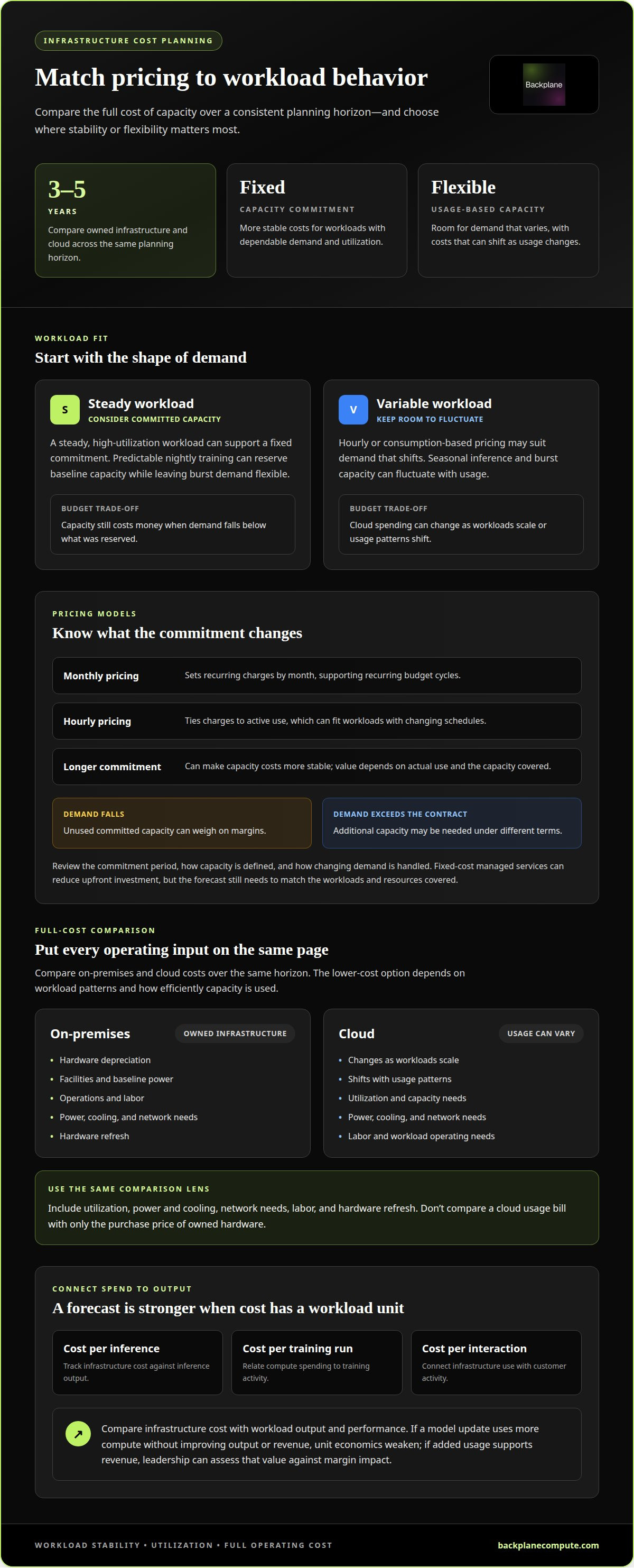
A fixed model sets charges by month, hour, or longer commitment instead of tying them entirely to consumption. Monthly pricing supports recurring budget cycles; hourly pricing ties charges to active use; longer commitments can make capacity costs more stable. The trade-off is utilization: committed GPUs still incur costs when demand falls below reserved capacity. Managed services with fixed costs can also provide access to modern tools without a large upfront investment. Shifting steady workloads from variable billing to a fixed commitment can make forecasts easier to build.
Comparing On-Premises and Cloud Costs
A three-to-five-year comparison should account for the full operating cost of owned infrastructure and the variable nature of cloud use. On-premises costs can include hardware depreciation, facilities, baseline power, and operations. Cloud spending can change as workloads scale or usage shifts. For example, a stable training workload may consistently use reserved capacity, while seasonal inference demand may fluctuate. Compare each model over the same planning horizon, including utilization, power and cooling, network needs, labor, and hardware refresh. The lower-cost option depends on workload patterns and how efficiently capacity is used.
Choosing a Pricing Model
A suitable pricing model aligns workload behavior with budget constraints. A steady, high-utilization workload can support committed capacity; a variable workload may suit hourly or consumption-based pricing. For example, a platform with predictable nightly training can reserve its baseline while keeping burst demand flexible. Include storage and network needs in the forecast, then weigh the cost of unused capacity against the value of stable budgeting. This makes the choice operational, not just a comparison of rates.
Fixed-Price Contract Trade-Offs
A fixed-price contract exchanges variable charges for a defined commitment, so its value depends on actual use. If demand drops, paying for unused capacity can weigh on margins. If demand exceeds the contracted amount, teams may need additional capacity under different terms. Before modeling the contract, review its commitment period, capacity definition, and treatment of changing demand. Managed fixed-cost services can reduce upfront investment, but the forecast still needs to reflect the workloads and resources covered.
Forecasting unit economics and protecting margins
A useful forecast connects compute spending to output, revenue, and workload demand. That connection shows whether infrastructure investment supports growth or compresses margins.
Infrastructure ROI and Unit Economics
Infrastructure ROI measures the value generated against the resources needed to deliver it. For AI products, teams can track infrastructure cost per inference, training run, or customer interaction. If a model update increases compute use without improving output or revenue, unit economics weaken. A stable cost per useful result gives finance and engineering teams a stronger basis for strategic investment. It also helps distinguish productive spending from capacity that adds little business value.
Forecasting and Monitoring Infrastructure Spend
Forecasting brings workload demand, capacity, and operating assumptions together to estimate a spend range. Analyze six months of usage to identify stable workloads, then model a scenario where usage doubles. Include power and cooling, network egress, support premiums, operations labor, hardware refresh, contract renewal, and migration. This gives a fuller view than compute charges alone. Teams can use the forecast to align budgets with planned model development and deployment.
A usable AI infrastructure cost model can forecast spending within 10 to 15 percent, giving engineering and finance a planning range. Compare that forecast with actual costs each period. Investigate variances by workload, utilization, and resource category, then refine assumptions rather than carrying forward a flawed baseline.
Review the model at least quarterly and whenever a material change occurs, such as a model release or deployment shift. Track spending alongside output measures, such as cost per inference, so a lower bill doesn’t conceal slower performance. Periodic variance analysis gives leaders a clearer view of financial stability and the return each workload contributes.
Infrastructure uncertainty and operational decisions
Infrastructure uncertainty changes decisions, not just forecasts. Costs can balloon by 50%, forcing a company to reverse planned growth or delay a launch. That pressure can push teams to postpone improvements, reduce redundancy, or choose reactive fixes. Each decision affects the ability to deliver consistent service. The operational risk is clear: a budget that shifts unexpectedly can constrain the capacity needed to support customers.
Consider a team planning to add redundancy to an AI inference platform. If infrastructure costs rise without warning, leaders may defer the investment to protect near-term budgets. Yet unexpected downtime can damage revenue and erode customer trust. Reactive spending to fix sudden problems can also cost more than effective planning. The decision is not simply whether redundancy costs more today, but whether workload performance and revenue depend on continuity.
Growth creates another pressure point. A flexible environment can absorb changing workloads, while dedicated capacity can support consistent performance and clearer planning. The right choice depends on workload stability, utilization, and the consequences of variable performance. Neither maximum flexibility nor maximum dedication is automatically best.
Boards can assess infrastructure through three connected measures: output consistency, revenue impact, and cost predictability. For an AI product, that means relating compute capacity to inference performance and customer activity. If scaling increases spending without improving service or revenue, the investment case weakens. If stable capacity protects throughput for a revenue-critical workload, its value extends beyond the infrastructure budget.
Operational planning should make these trade-offs explicit. Map workloads to their performance needs, identify where variability can affect returns, and test how growth changes capacity requirements. A hybrid approach can retain flexibility for changing demand while assigning sensitive workloads to dedicated infrastructure. This frames the decision around business outcomes, not cost alone.
For a financing structure aligned with infrastructure needs, explore infrastructure financing options.
Backplane: Infrastructure Financing Structuring
Backplane connects AI compute demand with powered industrial sites and structures financing to help turn underused assets into operational GPU farms. When a team needs capacity without waiting for hyperscaler queues, GPUs-as-a-Service provides access to GPU capacity. For organizations planning dedicated infrastructure, Dedicated Financed Sites offer another route. A Property Viability Assessment evaluates whether an industrial site can support an AI compute facility, while Infrastructure Financing Structuring addresses the capital framework for development. The right path depends on whether the priority is accessing compute or establishing dedicated capacity. Contact Backplane to discuss the infrastructure approach that fits your workload plans.
Turn Cost Clarity Into Your Next Move
Connect your infrastructure plan to the workload it must support. Base the decision on capacity needs, expected utilization, performance requirements, and a funding structure suited to your operating model. That makes predictable infrastructure pricing a practical input to growth planning, not just a budgeting goal.
Backplane supports different points in that decision: GPUs-as-a-Service for compute access, Dedicated Financed Sites for dedicated infrastructure, and Property Viability Assessment for evaluating a potential site. The right path depends on whether you need capacity now or are planning infrastructure for sustained demand.
Bring your workload requirements and infrastructure objectives into the conversation. Contact Backplane about predictable pricing and explore the next step for your AI infrastructure plan. Clear decisions today can give your team a stronger foundation for what comes next.
Frequently Asked Questions
What does predictable infrastructure pricing mean?
Predictable infrastructure pricing means having a clear basis for forecasting infrastructure spend as workload demand changes. It doesn’t require every charge to stay identical; it requires teams to understand which costs are committed and which vary with usage. For example, separating a stable inference baseline from experimental model runs helps finance distinguish planned capacity from discretionary spending.
What infrastructure pricing models offer the most predictable costs?
Committed-capacity models generally provide stronger cost visibility because charges are tied to reserved resources or a defined term. Monthly commitments can suit ongoing workloads, while longer commitments can support sustained demand. Hourly or usage-based models preserve flexibility when utilization changes. A blended approach can reserve capacity for a stable production workload while leaving experimentation or seasonal demand on a variable model.
What hidden fees and usage-based charges can make infrastructure bills unpredictable?
Infrastructure bills can rise through data transfer, storage growth, autoscaling, and consumption beyond committed capacity. Support-tier premiums, power and cooling, hardware refresh, renewal terms, and migration can also affect total ownership costs. For example, a workload may stay within its compute allocation but still incur higher charges as datasets expand or data moves between environments. Track these components separately in forecasts.


