
An AI data center can be structurally complete and still be far from ready to deliver compute. AI data center construction risks often emerge at the interfaces: a delayed utility connection can leave installed systems waiting for power, while a cooling change can trigger electrical redesign, procurement shifts, and a tighter commissioning window.
Power timing, high-density cooling, long-lead equipment, permitting, and commissioning are familiar concerns. The challenge is how quickly one constraint can amplify another, putting the schedule and committed capital at risk. Managing each issue in isolation can leave those connections hidden.
This guide shows where projects can go off track, how risks compound, and which practical controls, owners, and decision gates can bring issues into view before they threaten delivery. It connects site readiness, utility power, cooling and electrical design, procurement, approvals, commissioning, financing, and compute demand. That joined-up view helps teams assess project viability and align infrastructure with the delivery plan.
Key Takeaways
- Define construction risk by its effect on safe delivery, schedule, cost, or usable compute capacity. Separate execution risks from earlier site and financing decisions.
- Assess power, cooling, and equipment as connected dependencies. A constraint in one can reshape design, procurement, and commissioning.
- Compare AI data center construction risks by likelihood, consequence, detectability, dependencies, and accountable mitigation owner, rather than relying on arbitrary scores.
- Use stage gates for design freeze, procurement release, construction readiness, systems testing, and handover to surface unresolved decisions before the next phase.
- Align property, power, capital, deployment, and compute requirements early. Backplane connects powered industrial sites with AI compute demand and supports project assessment and financing structuring.
AI Data Center Construction Risks Start Before Groundbreaking
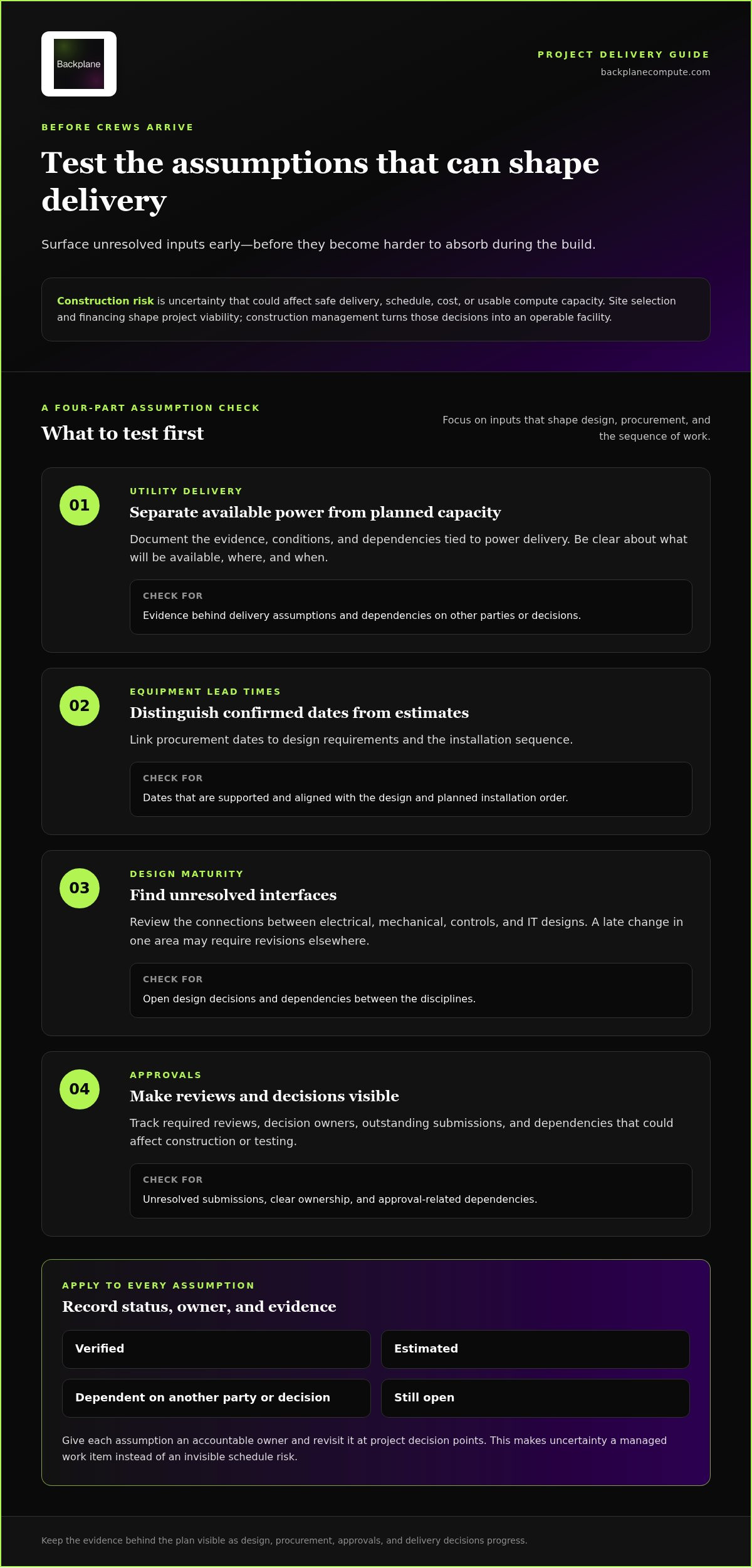
Construction exposure begins before crews arrive. A project may carry unresolved assumptions about utility power, equipment, design, or approvals into the build, where each becomes harder to absorb. In this guide, construction risk means uncertainty that could affect safe delivery, schedule, cost, or the usable compute capacity the facility is meant to support.
An AI data center construction risk is any uncertainty that can prevent the facility’s people, systems, and compute infrastructure from being delivered safely and working together as intended. This definition keeps the focus on execution. Site selection and financing decisions shape whether a project is viable; construction management turns those decisions into an operable facility. The two are connected, but they call for distinct controls.
Why AI data center projects have tightly coupled workstreams
AI facilities bring electrical distribution, mechanical cooling, controls, and IT infrastructure into close coordination. The workload determines compute requirements, which shape power and heat loads. Building systems must support both. An AI data center overview provides background on these facilities and their power and water demands, important considerations in project planning.
A finished shell is not the same as an operational facility. Incomplete power distribution can prevent integrated testing from proceeding as planned. If cooling controls or compute equipment are not ready, teams may be unable to test systems under intended operating conditions. A delay in one critical system can compress downstream testing, issue resolution, and handover.
Which project assumptions should be tested first?
Start with assumptions that shape design, procurement, and the sequence of work. For each input, record whether it is verified, estimated, dependent on another party or decision, or still open. This shows which parts of the schedule rest on evidence and which rest on expectations.
- Utility delivery: Distinguish available power from planned capacity. Document the evidence, conditions, and dependencies tied to delivery.
- Equipment lead times: Separate confirmed equipment dates from estimates. Link procurement dates to design requirements and the installation sequence.
- Design maturity: Record unresolved interfaces between electrical, mechanical, controls, and IT designs. A late change in one area may require revisions elsewhere.
- Approvals: Track required reviews, decision owners, outstanding submissions, and any dependencies that could affect construction or testing.
Give each assumption an owner and status, then revisit it at project decision points. This makes uncertainty a managed work item instead of an invisible schedule risk. For upstream property and location diligence, the AI data center site selection criteria address decisions that precede construction planning.
Backplane connects powered industrial sites with AI compute demand and supports project assessment and financing structuring. This work underscores a core delivery principle: site readiness, committed compute requirements, funding, and infrastructure plans need to align before execution assumptions harden.
Power, Cooling, and Equipment Create the Core AI Data Center Construction Risks
The central delivery challenge is not simply installing more capacity. Utility supply, electrical distribution, cooling systems, and compute equipment must work together as one coordinated facility. At these interfaces, AI data center construction risks can turn a design assumption into a procurement change, testing constraint, or delayed handover.
Installed capacity is equipment in place; commissioned compute capacity is equipment that has been integrated, tested, and shown to operate as intended. The distinction matters. A room can be built and major components installed while unresolved power or cooling dependencies still prevent the target compute systems from running.
Power delivery and electrical integration risks
Power readiness extends from utility coordination through site distribution. The chain may include the interconnection, incoming service, transformers, switchgear, backup systems, and distribution to the equipment. Each stage depends on design decisions, equipment procurement, installation, and coordination between responsible parties. Planned power and available power are not interchangeable. The project needs clear evidence of what will be available, where, and when.
Track each dependency in one register. Assign an accountable owner, record supporting evidence, and set a decision date. Flag changes to load assumptions, unavailable equipment, and incomplete interface specifications early. For example, a change in intended compute load can affect electrical design and equipment selection, then alter procurement and installation sequencing. A visible decision point gives the team time to assess those effects before they reach testing.
Cooling and high-density equipment coordination
Cooling choices need to match the intended workload, equipment requirements, and facility layout. Rack-level needs affect heat removal, mechanical capacity, electrical demand, and the space available for piping, cabling, and maintenance access. Liquid cooling may suit a particular design, but it is not a universal requirement. If selected, its interfaces, controls, equipment, and commissioning procedures belong in the delivery plan.
Use applicable ASHRAE guidance as a technical reference, then verify which guidance and project-specific requirements apply to the facility and its intended operating conditions. Keep mechanical and electrical design reviews coordinated: a cooling decision can change power needs, while a layout revision can affect service access and system installation.
Long-lead electrical and mechanical equipment can put the schedule at risk even when construction is progressing. Link procurement status to the approved design, required interfaces, delivery evidence, installation sequence, and testing prerequisites. A purchase order or forecast date alone does not prove an item is ready for the next milestone.
- Power: Record the dependency, evidence, owner, and decision date for each delivery and distribution milestone.
- Cooling: Align the chosen approach with equipment requirements, layout, controls, and test procedures.
- Equipment: Connect procurement and installation status to design maturity and downstream commissioning needs.
Coordinating property readiness, power, and compute requirements is part of aligning powered sites with AI compute demand. This alignment helps project stakeholders assess infrastructure dependencies before they become disconnected schedule assumptions.
How to Compare and Prioritize AI Data Center Construction Risks
A risk register is useful when it helps the team decide what needs attention first. Compare each exposure by likelihood, consequence, detectability, dependency, and mitigation ownership. Risk priority reflects both impact and dependency, not severity alone. A moderate issue tied to several downstream tasks may need attention before a severe issue with a clear workaround and no schedule impact.
A practical risk matrix for project teams
Use consistent qualitative definitions across project stakeholders. Likelihood should reflect the evidence that a risk may occur. Consequence should describe its effect on safety, schedule, cost, or usable capacity. Detectability asks how early the team can identify it. Dependency captures which work relies on resolution. Use the table as a prompt for project-specific assessment, not as a source of fixed ratings.
Risk area | Likelihood and consequence to assess | Detectability and dependency | Mitigation owner
Power: Utility or distribution dependency remains unresolved | Evidence of delivery and effect on energization | Can the issue be identified before downstream work depends on power? | Utility interface or electrical lead
Cooling: Design or controls may not support intended operating conditions | Design maturity and effect on equipment operation | Can a mismatch be found before integrated testing? | Mechanical and controls leads
Equipment: Delivery or installation may not align with the approved sequence | Procurement evidence and effect on critical work | Is the constraint visible before installation or testing? | Procurement lead
Permitting: An approval or review may remain open | Status and consequence for authorized work | Is the outstanding decision visible before the affected activity? | Permitting lead
Safety: A work activity presents a hazard requiring control | Exposure and potential harm | Can the hazard be identified before work begins? | Site safety lead
Commissioning: Systems may not be ready for integrated testing | Test prerequisites and handover impact | Are incomplete interfaces visible before test windows? | Commissioning lead
For each risk, record its cause, event, consequence, owner, trigger, mitigation, and residual exposure. Escalate when supporting evidence changes, a decision date passes, mitigation fails, or a critical-path activity can no longer proceed as planned. For example, a power delay can hold up energization, constrain equipment testing, and push compute activation. Track that chain, not only the original utility issue.
Where construction risk meets capital and demand
Schedule slippage can change the timing assumptions behind capital deployment and committed compute plans. If a facility cannot reach operating readiness as planned, funding milestones and demand activation may no longer align with construction progress. Track these links as dependencies and exposures, while keeping construction controls distinct from capital structuring. For the separate discussion of capital planning, financing AI infrastructure covers the structuring considerations.
Prioritize risks that threaten a critical path, affect multiple workstreams, or are difficult to detect until late. Assign one accountable owner to coordinate mitigation, even when several teams contribute. For complex infrastructure investments, independent advisory partners like Swiss Alpha Matrix support this process by delivering rigorous due diligence and project management oversight across multi-stakeholder programmes. This keeps decisions moving and makes residual exposure visible to those responsible for delivery.
Control AI Data Center Construction Risks With Stage Gates
Stage gates turn project intent into documented release decisions. Each gate should specify the required evidence, who approves it, which dependencies remain open, and what conditions prevent work from advancing. This gives teams a consistent way to manage AI data center construction risks across design, procurement, field execution, and handover.
Use the gates in sequence, but keep them active throughout the project. For example, a major design change after procurement release should reopen affected decisions rather than pass through as a routine update.
- Design freeze: Confirm that electrical, mechanical, controls, and compute interfaces are coordinated enough to support procurement. Record exceptions and assign owners and resolution dates.
- Procurement release: Release equipment against approved specifications and documented interfaces. Identify substitutions or unresolved selections that could affect installation, system compatibility, or test plans.
- Construction readiness: Verify that the work area, approved design information, required materials, safety planning, and prerequisite decisions are ready before affected activities begin.
- Systems testing: Confirm that test procedures, equipment, dependencies, and responsible personnel are in place. Track defects through resolution and retesting.
- Handover: Define the acceptance evidence, operating documentation, outstanding items, and responsibility for each open issue before declaring delivery complete.
Change control should assess effects across power, cooling, schedule, safety, and commissioning. An equipment substitution may appear isolated but change interface requirements or invalidate a planned test. Record the decision, rationale, affected work, approver, and any revised acceptance criteria. Include safety and regulatory reviews at the relevant gates, and verify the requirements that apply in the project’s jurisdiction rather than assuming they are uniform.
Build a living risk register and escalation path
Review the register at defined project meetings. Update it with current evidence, triggers, accountable owners, due dates, mitigation actions, and residual exposure. Escalate a critical-path dependency when its decision date is missed, supporting evidence changes, or the next activity can no longer proceed as planned. Keep an issue open until mitigation is verified. Completing an action does not automatically mean the underlying exposure has disappeared.
Commission systems before declaring delivery complete
Plan integrated testing across electrical, cooling, controls, and compute interfaces. Sequence tests around their prerequisites, define the evidence required for acceptance, and document how faults are reported, resolved, and retested. Assign responsibility for running tests and accepting results at each interface. For broader infrastructure context, see this high-performance computing infrastructure guide.
Backplane connects powered industrial sites with AI compute demand and supports project assessment and infrastructure deployment. Explore how Backplane connects site readiness with compute demand when aligning project dependencies and delivery decisions.
Align Site, Capital, and Compute Before AI Data Center Construction
A construction plan can be internally consistent and still rely on mismatched project inputs. A property may be available before power assumptions are resolved. Compute requirements may change after infrastructure decisions advance. Capital commitments may follow a schedule that depends on approvals or equipment decisions still in progress. These gaps increase AI data center construction risks because no single workstream can establish readiness on its own.
Delivery improves when property owners, compute buyers, technical teams, and capital stakeholders share a view of the project. That view should connect what the site can support, what the intended workload requires, what infrastructure must be deployed, and which commitments depend on unresolved evidence. The goal is not to eliminate uncertainty. It is to make dependencies visible before the next commitment makes them harder to address.
Turn project dependencies into coordinated decisions
Map decisions that connect each stakeholder’s work. Compute requirements inform infrastructure planning; site and power conditions shape what can be deployed; and project readiness influences the timing of capital and delivery commitments. Give each decision an owner, an evidence requirement, a decision point, and a record of what remains unresolved.
Before advancing a major commitment or project gate, stakeholders can ask:
- Property: Does the site’s assessed viability align with the project’s intended infrastructure and compute requirements?
- Power and infrastructure: Which assumptions are supported by evidence, and which still depend on future decisions or delivery?
- Compute: Are the intended workload and deployment requirements defined enough to inform infrastructure planning?
- Capital and schedule: Do project commitments reflect current readiness evidence and known dependencies?
These questions distinguish verified inputs from expectations and expose gaps in ownership. If a decision affects several workstreams, name one accountable owner to coordinate it, while recording the teams responsible for the supporting evidence and actions.
What a risk-aware project path looks like
Start with property viability assessment tied to intended compute demand and infrastructure requirements. Use the resulting evidence to inform project assessment, financing structuring, and deployment decisions. Sequence commitments around readiness and dependencies, not just a target date. If a key assumption changes, update the affected decisions and schedule expectations across stakeholders.
Backplane connects powered industrial sites with AI compute demand and supports site assessment, financing structuring, and infrastructure deployment. This work sits at the intersection of property, power, capital, and compute, where coordinated decisions help stakeholders see project constraints as a connected system rather than separate workstreams.
No single technology choice removes delivery uncertainty. Clear ownership, evidence-based decisions, and disciplined coordination help keep project requirements aligned as work advances. For a closer look at this approach, explore Backplane’s AI infrastructure approach.
Make the Next Project Commitment With Confidence
Apply the risk framework to a live project decision. Identify the commitment that would be hardest to reverse, then test the assumptions behind it against current evidence. Treat a schedule or design baseline as a working position, not a permanent truth. When requirements shift, revisit the affected decisions before changes travel downstream.
This discipline gives stakeholders a clearer basis for action and keeps AI data center construction risks visible as a project moves from planning into delivery. Progress does not mean eliminating uncertainty. It means knowing what remains uncertain, who owns it, and what must be true before the next commitment.
To bring site readiness and compute demand into the same view, explore how Backplane connects powered sites, financing, and AI compute. Start with the project decision that most depends on those inputs.
Frequently Asked Questions
What are the biggest risks in AI data center construction?
Common AI data center construction risks include power delivery, electrical and cooling integration, long-lead equipment, permitting, worker safety, and commissioning. Their priority depends on the project’s design, location, delivery sequence, and dependencies, so no category ranks first for every facility. A completed building, for example, may still lack tested electrical and mechanical systems, leaving the intended compute equipment unable to operate as planned.
Why is power delivery a major risk for AI data center construction?
Power delivery depends on coordinated steps, from utility and interconnection arrangements to electrical equipment, distribution design, and testing. A change or delay at one point can affect downstream installation and commissioning. Treat planned capacity as an assumption until evidence establishes what is available and when. Track each dependency with a responsible owner, dated evidence, and a decision date so the team can respond as conditions change.
Can cooling problems delay an AI data center project?
Yes. Cooling must fit the intended workload and equipment layout while coordinating with electrical capacity, controls, and commissioning plans. A late change to rack arrangements, for instance, may require teams to revisit related mechanical and electrical decisions. No single cooling approach suits every facility. Resolve design assumptions early, document project-specific operating requirements, and test integrated systems against those requirements before treating cooling readiness as established.
What happens if long-lead equipment arrives late?
A late delivery can disrupt installation sequencing, hold up critical-path work, reduce time for integrated testing, or shift handover. The effect depends on how many downstream activities rely on the equipment and whether the schedule has flexibility. Track procurement decision dates and supplier milestones against the approved design. Plan responses for critical items in advance, and assess any proposed substitute for compatibility rather than assuming components are interchangeable.
How can project teams reduce construction risk at an AI data center?
Use a living risk register that assigns owners, defines triggers, and records evidence, due dates, mitigations, and remaining exposure. Coordinate design reviews across disciplines and use change control to assess effects before approving revisions. Stage gates test readiness before commitments advance. Include integrated testing and documented handover criteria. Connect controls across power, cooling, safety, schedule, and compute readiness, while recognizing that these measures manage exposure rather than guarantee delivery dates.
How is AI data center construction risk different from ordinary construction risk?
AI data center construction combines conventional building work with power-dense electrical systems, specialized cooling coordination, compute equipment, and complex systems integration. Standard construction concerns, including safety, approvals, and sequencing, still apply—areas where specialized building consultancies such as pkservices.com.au assist project teams with industry delivery standards. The added challenge is how technical dependencies compound across workstreams: a change to workload assumptions may affect design and equipment decisions. Each project’s workload, location, design, and delivery model determines its risk profile.


